
KEY TAKEAWAYS
- Underground service locating and boundary verification happen before any machine breaks ground.
- Stripping organic topsoil prevents decomposition and settlement beneath future slabs and pavements.
- Controlled fill must be placed in thin, moisture-conditioned lifts and verified against engineering specs.
1. Pre-Start Checks: Surveys, Permits and Underground Utilities
Every productive earthworks package begins off the machine. Before plant arrives on site, contractors verify registered boundary pegs against the feature and level survey, check local council conditions for tree protection or crossover access, and review current Before You Dig Australia (BYDA) utility plans.
Paper plans indicate asset corridors, not exact depths. Electronic locating and non-destructive potholing confirm the real position of water mains, gas lines, telecommunications conduits and underground power so bulk excavation can proceed safely.
- Confirm registered boundary marks and temporary site benchmarks (TBM)
- Install sediment fences, shaker grids and stockpile containment zones
- Establish safe heavy-vehicle entry and pedestrian separation along the frontage
2. Clearing and Stripping Unsuitable Surface Material
Grass, roots, mulch and dark organic topsoil compress and decompose over time. Leaving organic layers underneath a building pad or driveway creates voids and uneven settlement.
During stripping, excavators peel back the organic horizon and any loose, uncontrolled fill until natural, competent ground is exposed. Clean topsoil needed for later landscaping is stockpiled away from the structural zone, while excess or unsuitable spoil is scheduled for removal.
3. Cut-and-Fill Benching and Subgrade Proof Rolling
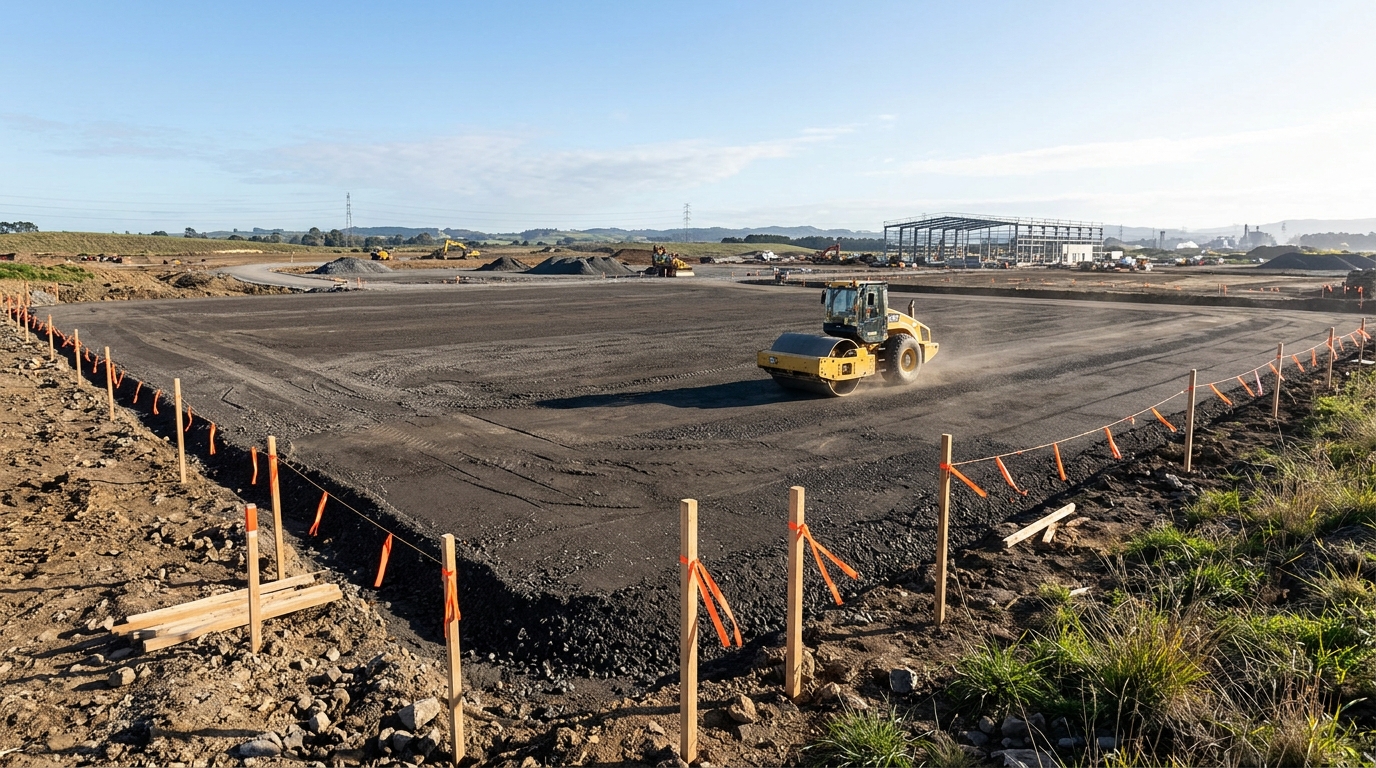
On sloping allotments, earthmovers cut into the high side of the block and form level benches to match the engineered pad reduced level (RL). Once natural subgrade is exposed, a heavy roller proof-rolls the surface while operators and geotechnical technicians watch for deflection or "pumping"—a clear sign of trapped moisture or soft clay pockets.
Where soft spots appear, they are boxed out to firmer ground and replaced with compacted select fill or crushed rock rather than simply bridged over.
4. Controlled Fill Placement and Compaction Verification
When fill is required to raise part of a building platform, how it is placed matters just as much as the material itself. Pushing thick mounds of dry clay into place with an excavator bucket leaves air voids that later collapse when wet.
Engineered fill is spread in thin horizontal lifts, moisture-conditioned so soil particles bind properly, and compacted with padfoot or smooth-drum rollers. On projects requiring Level 1 or Level 2 earthworks supervision, a geotechnical technician conducts field density tests across lifts before issuing a compaction report.
Technical Note: Always check your structural footing drawings before importing fill—engineers specify exact material plasticity, maximum particle size and compaction percentages.
5. Surface Drainage Protection and Pad Handover
A freshly trimmed clay pad can be spoiled overnight if stormwater runs across it unimpeded. Good site preparation finishes with slight surface falls or temporary uphill cutoff swales that divert runoff around the pad perimeter until permanent stormwater lines and concrete slabs are installed.